Just as Napa Valley boasts a variety of wine grapes, from Albariño to Zinfandel, the architecture of its wineries is wide ranging, with influences as diverse as Greek mythology and couture gowns. Whether the buildings appear amid a backdrop of flourishing vines or are discreetly nestled on the grounds, there’s a throughline: designs that evoke a sense of place, where world-class wines and singular tasting experiences await.
For some firms, a winery represents a rarity in their portfolio. Michael Graves, the postmodernist pioneer who passed away in 2015, designed more than 350 buildings during an illustrious career that spanned five decades, yet Clos Pegase was his only winery. Other architects more prolific in the valley, like Howard Backen and Jon Lail, often cite the setting as a continuing driving force. Also top of mind are production needs (to yield the finest wines) and visitor amenities (Clos Pegase’s Cave Theater, for instance, holds concerts and dinners). As a result, wineries combine some of the most beloved aspects of Napa Valley culture—food, wine, the arts—in one place.
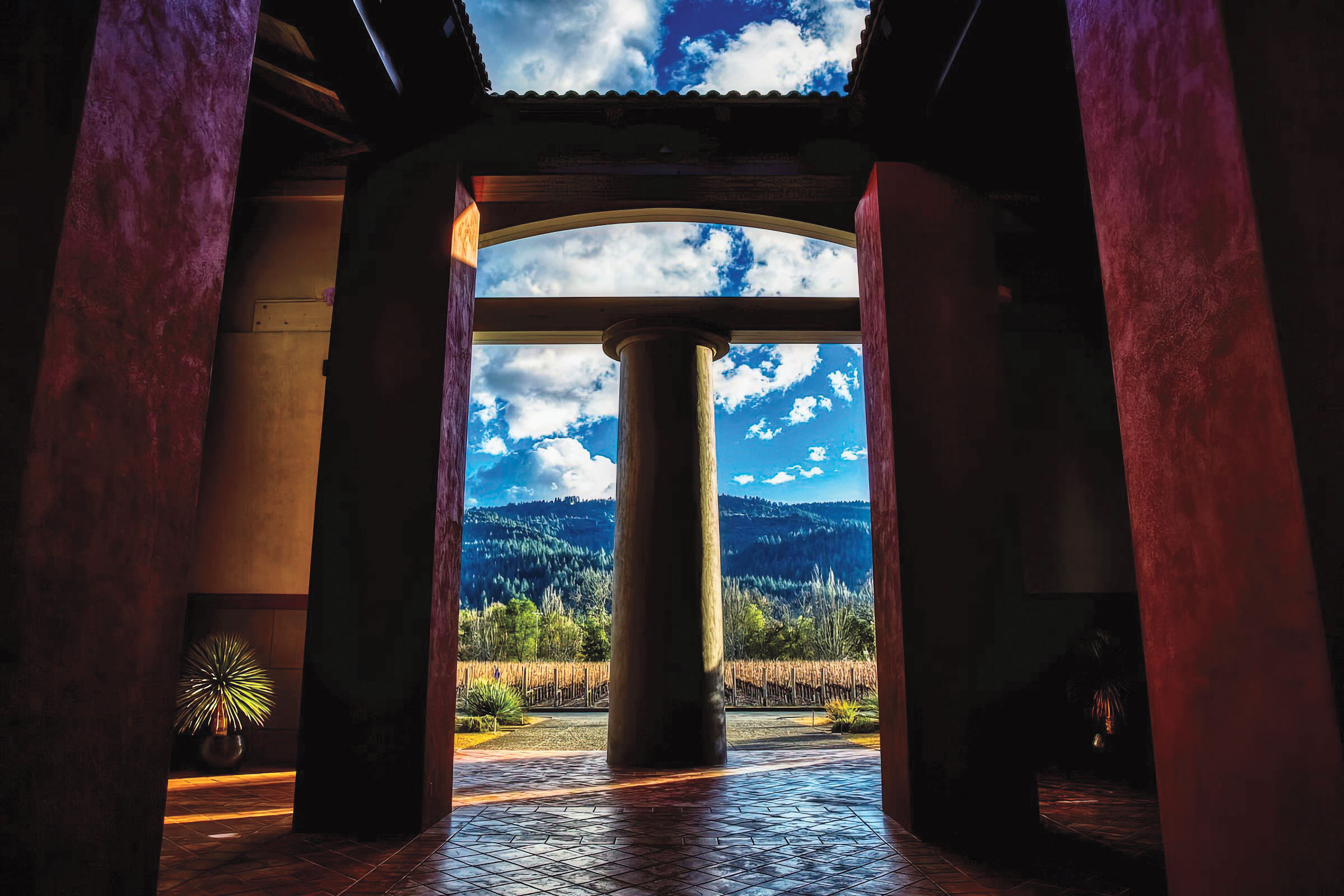
In 1984, the then-proprietors of Clos Pegase, Jan and Mitsuko Shrem, in conjunction with the San Francisco Museum of Modern Art, held a competition to select the winery’s architect. “Michael Graves’ vision incorporates a principle of Greek mythology which separates the worlds of work and play,” says Mary Ann Vangrin, vice president of communications at Vintage Wine Estates, which owns Clos Pegase. “Grand Minoan columns essentially divide the winery in half, with one side dedicated to winemaking and the other side to celebrations, tastings and hospitality.”
In a 2010 interview, Graves, who was up against 95 other entrants, recounted that his goal was to “make a winery that worked. Wineries were starting to be designed by modern architects that were more about modern architecture than they were about wineries and the history and substance of winemaking.”
Vangrin notes that Graves “was inspired by the climate and the light in the Calistoga AVA.” A veranda overlooking the estate Applebone Vineyard offers a prime spot for tastings, while cave tours impart further winemaking insight. The winery is sited at the bottom of a volcanic knoll—a solid rock that houses 20,000 square feet of caves. “Aging wine in the rock is ideal because of its constant temperature of exactly 62 degrees year-round and 70 to 80 percent humidity,” explains Vangrin.
Much like wine, architecture can embody preservation and innovation. Take the Backen-designed Dana Estates winery, completed in 2010. The property’s vinification history, however, dates to 1883. “Having a 140-year-old winery ruin is the first reason that I fell in love with the land,” says Dana Estates owner Hi Sang Lee. “Howard did a great job of mingling the original old structure with the new addition to make it look like it has been there forever.”
Lee had seen Backen’s work at Harlan Estate and “really loved his style of design,” he says, referring to it as “original yet very natural and not showy.” For Dana Estates, Lee desired a balance between contrasting elements: “old and new, East and West, outdoor and indoor, and fire and water.”
Rustic and elegant are also apt descriptors of Backen’s oeuvre. Since arriving in Napa in the 1990s, Backen has designed numerous wineries. The renowned architect has stated that rather than executing a certain style, he is compelled by the site and the land.
Winemaker Philippe Melka, who is currently consulting with Dana Estates, also participated in the design process. Lee recalls many hours discussing materials—stone, wood, metal, concrete. The main concern, he says, was making the best possible wines, “so every single material is chosen by the production team, and Howard made sure that those materials look good.”
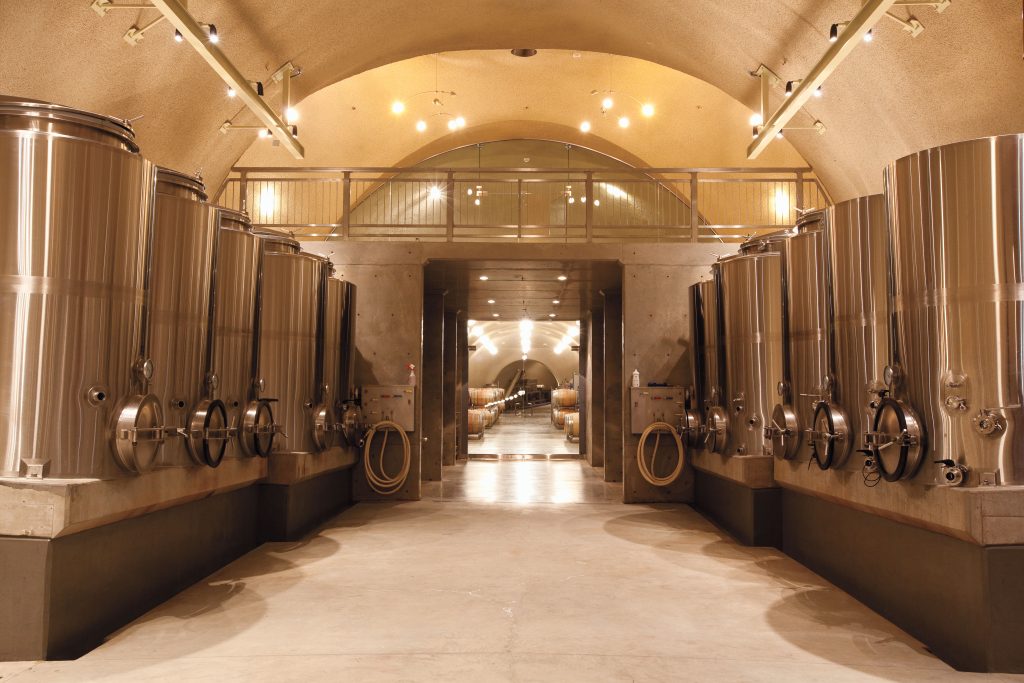
At Ron and Susan Krausz’s Arkenstone Vineyards, the facilities rely on the low-tech (like gravity to move the fruit) and the state-of-the-art (pneumatic punch downs). The natural beauty and health of the Howell Mountain site were also considerations. To help maintain the integrity of the landscape, production happens subterraneously—with the exception of the above-ground crush pad.
The Krauszes enlisted Lail, whom they previously worked with on a residential endeavor. “We knew that as a longtime Napa resident, he understood the valley well,” says Susan Krausz. Lail moved to the area in the 1970s with his wife, Robin Daniel Lail, who later founded Lail Vineyards. “Jon and his team had the knowledge, skills, creativity and ability to navigate the complexities of the project,” Krausz adds.
A contemporary barn composed of metal in earthy hues nods to the region’s agricultural roots. “We wanted the tasting room to be elegant, yet welcoming, and have an unimpeded view of the vineyards, forest, meadow and mountains,” Krausz elaborates.
Sustainability is a priority at Arkenstone, which has “continuously farmed organically since the first plantings in 1998,” says Krausz, noting that winemaker Sam Kaplan is always on the lookout for new technology and practices with long-term benefits. (A recently purchased electric tractor reduces the use of diesel.)
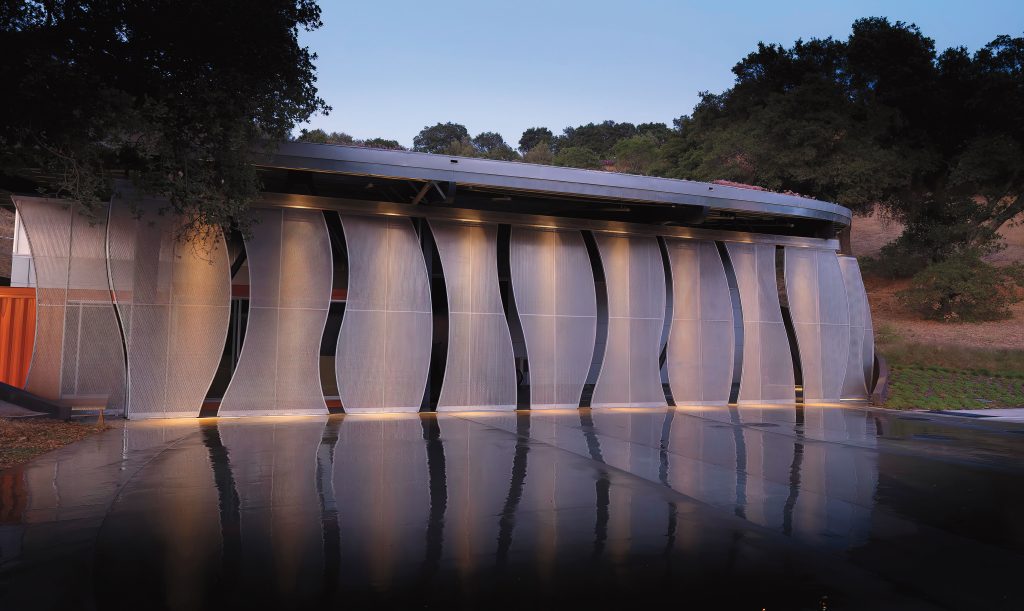
According to John Conover, general manager and partner at Odette Estate Winery, its LEED Gold certification and CCOF accreditation reflect “our approach of not ‘owning’ any of the wineries, but being stewards of the land and locations from which we make wine.” Indeed, Odette architect Juancarlos Fernandez’s concept was “dictated by the space and surrounding hills,” he says. (Prior to forming Signum Architecture with Jarrod Denton in 2011, Fernandez was a senior designer at Lail Design Group.)
Two key features at Odette are the living green roof and sliding perforated aluminum screens. The shapes of the latter, which shade the crush pad and work area, were inspired by Oscar de la Renta dresses. Strikingly, the winemaking laboratory occupies recycled shipping containers. “It’s ahead, it’s different, it’s efficient. … There’s nothing else like it,” says Fernandez.
It’s not only structures that are being reimagined, though. In 2015, Clos Pegase removed its water-thirsty lawns and installed a heritage garden with drought-tolerant plants and trees.
“We have seen so many beautiful winery projects throughout Napa Valley,” says Susan Krausz. “Each one tells a story of the ever-changing face of the valley and the folks who inhabit this amazing place.”
—
Anh-Minh Le is a freelance writer and editor whose bylines have appeared in The San Francisco Chronicle, WSJ. Magazine, California Home+Design and C Magazine, among others. She is based in Portola Valley, CA.